

Journey Among Worlds
A trip to a remote Danish village

But in front of me there is a vista – empty, but inexpressibly spacious. Between those two – landscape of stone, and wide blue air – is where I am.
Nuala O’Faolain, from her memoir “Are You Somebody?”

I. Copenhagen - Sjællands Odde
I had less than half a minute to decide whether to hop on a train that might bring me closer to my remote destination, a village on a Danish peninsula. My previous train was late, so the seven-minute transfer vanished, replaced instead by a hopeful sprint towards the next platform. The aliveness of travel is condensed into these split-seconds that can derail our journey or keep us on track. The second train successfully took me deeper into the Danish countryside, and closer to the coastline.
For those of us who never feel fully settled at home, remote places can temporarily cure our restlessness - the slower pace lets our mind and body sink into a different kind of unfolding. Maybe, for a few good, long moments, we can feel more accommodated in the world.
With that particular thought in my mind, I disembarked from my last train and walked towards the bus station as it slowly started drizzling. The air smelled floral and earthy, and the quietness of the place was pierced every ten seconds by a robotic voice from the train station opposite me, inviting people to “check in”.
Once settled into one of the last buses heading towards Sjællands Odde that evening, I let my body sink into the chair and, for the first time, completely surrendered to the environment - I was soon to arrive in Havnebyen. The fields were bright yellow, rapeseed flowers covering the earth. I felt a joyous jolt through my body, remembering the countryside back home in Romania.
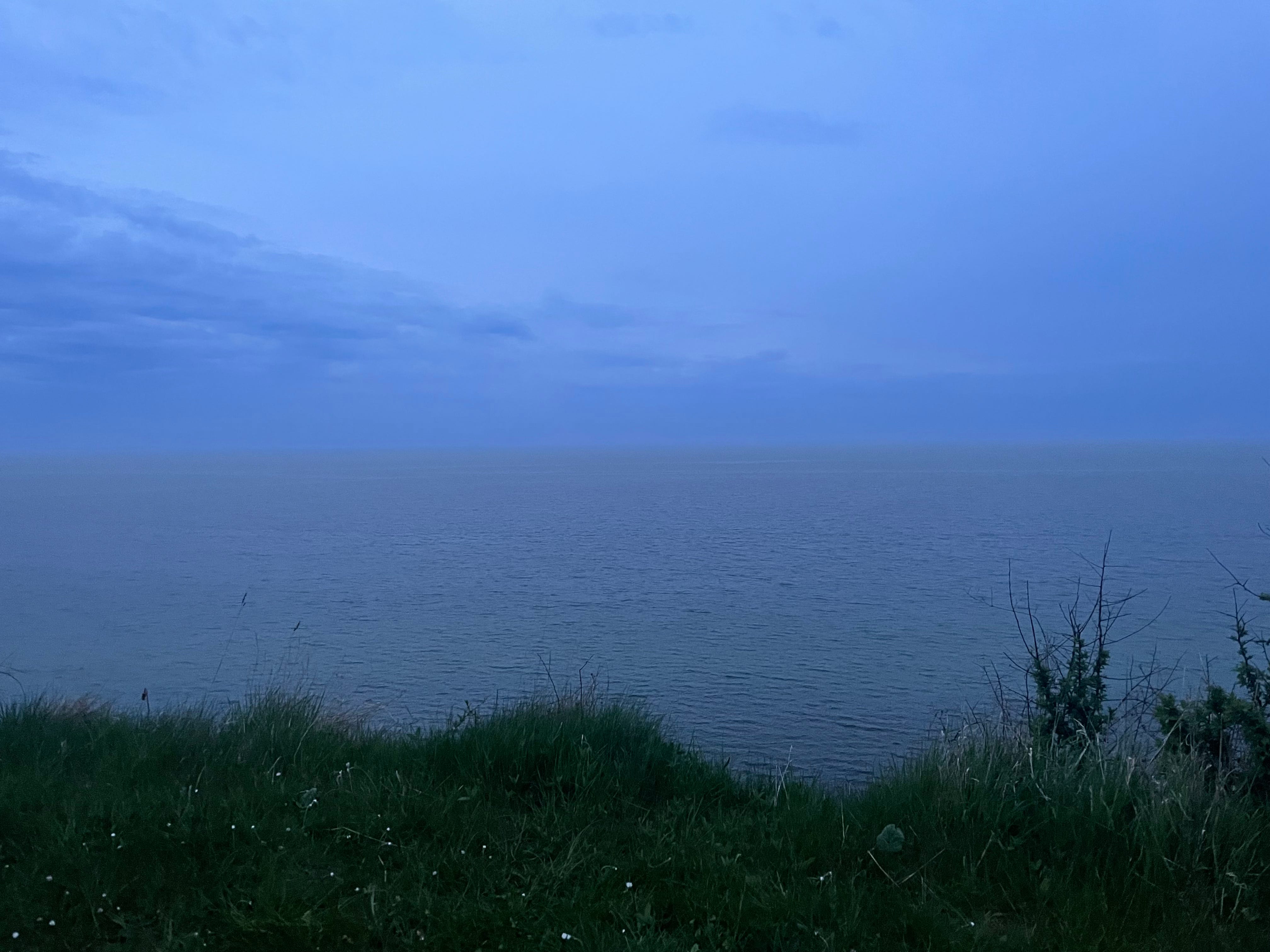
That feeling lasted a few seconds before the bus drew closer to the coastline, and my eyes were met with the bay mirroring the entire sky - the horizon vanished, and there was only a serene pearl grey-blue stretching as far as I could see.

II. Havnebyen
I might never have visited this place in my lifetime if it weren’t for Silvia Paizan’s invitation. I met her through the newsletter of a fellowship we are both part of, and I reached out to her because I loved her aesthetics and sensitivity as a visual storyteller. She created the logo and dividers for this newsletter.
Little by little, call by call, we formed a friendship grounded in our shared Romanian roots and our desire to create something creatively honest and free. Then, about a year ago, she left her city, Sibiu, in beautiful Transylvania, and moved to a remote place in Denmark to begin a new life in her thirties.
As with most of my journeys abroad, I carried questions, all of which could be distilled into a single one this time: where do you feel at home now? I asked Silvia this question as I was already succumbing to the comforts of her place: a homemade dinner, deliciously pickled goods, a selection of Danish cheeses, flickering candles, cats lounging on the wooden floors, and the faint lights of the village houses in the windows.
Uprooting oneself this way - alone, in a new country, with no support system, no secure job, facing so many unknowns - is not a small leap of faith. There is a great deal of unlearning and learning on this journey; the risks are daunting, the rewards exhilarating. One risk is never stopping the search for home, remaining suspended between worlds: “back home” and “home now”, with fragments of comfort, ease, stories, and familiarity scattered here and there.

III. The Bay
After dinner, Silvia and I headed towards the first place where she felt at home after moving abroad. It’s a short walk from her house, on a hill with a bench overlooking the bay. In front of us, different shades of ink-dark blue overlapped, with elegant, quiet waves adding movement and extending that deep colour beyond the horizon.
As I spoke with Silvia, I understood why this place could feel like home; it is so free and open that it can hold all of our unlearnings, all of our exhales.
A man in a hoodie was photographing the building nearby with hypnotic attention, circling the place once or twice to capture details I found myself curious about too. Silvia recognised him from previous walks. I felt a certain unease at first, as the sky darkened and the night settled fully in - but as I sank deeper into that place, that village, I realised that my rhythm still did not match the one I had stepped into there.
My unease was cautiously replaced by curiosity: what drives someone to keep returning to a place where he already lives, photographing and recording it over and over again? In a city, he might have passed unnoticed, but here, in this openness, his curiosity drew attention. We stand out more in these remote places; our human stories have more room to pour themselves onto the landscape.

IV. The Kiosk
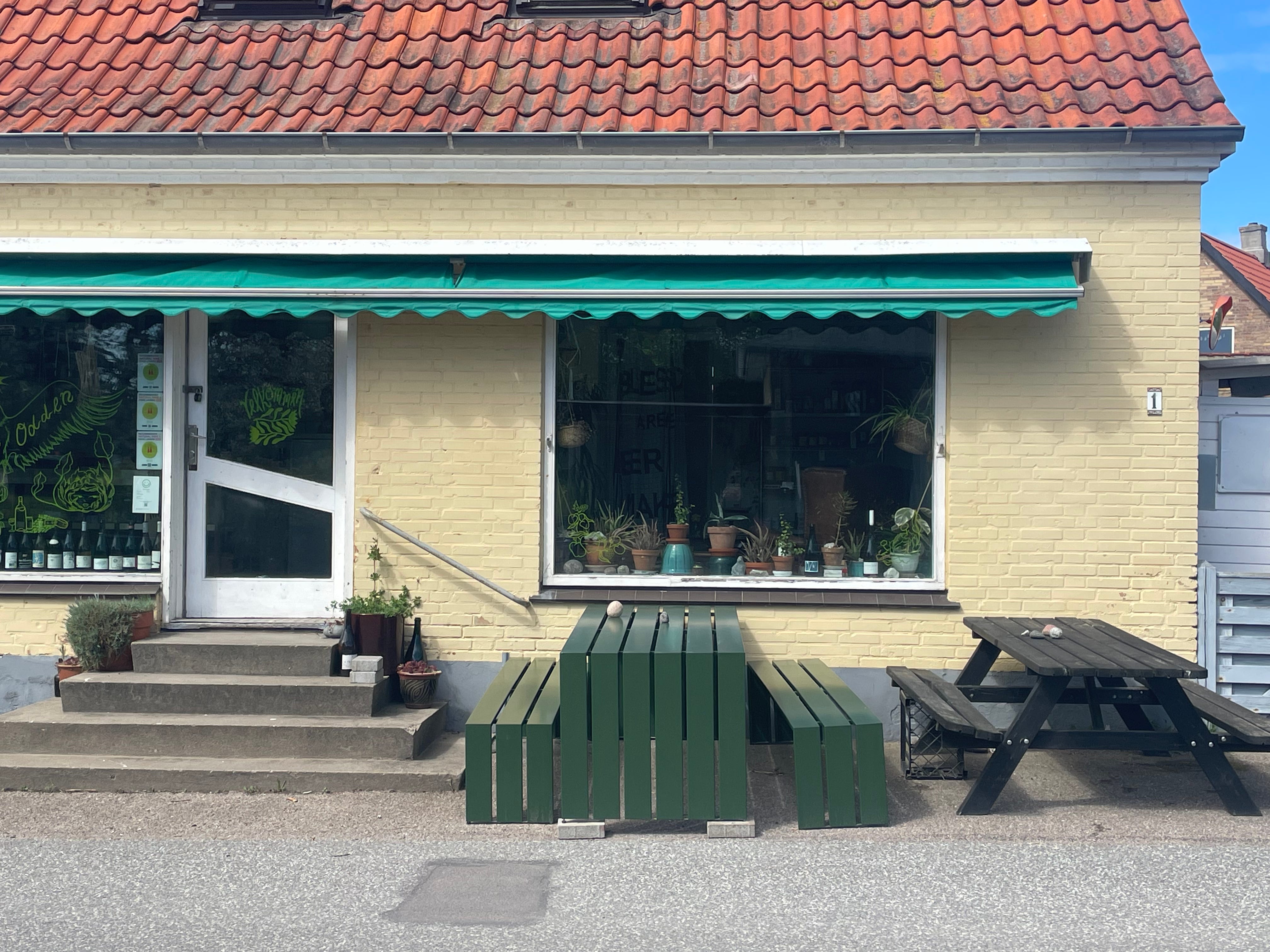
On the second day of the journey, I spent quite a lot of time in the shop, Kiosken på Odden, the front room of the house where Silvia and her housemate sell pickled goods, cheeses, a good selection of natural wines, handmade soaps, chocolate, oils, and many other tempting things.
The room holds a refrigerator that produces an almost continuous sound, a deep metallic hum that reminded me of the fridge my grandparents had in the countryside. That sound alone attuned me to the rhythm of the place.


Later that day we headed to Odden Fisk, an excellent fish shop by the harbour, to pick up a few things for our picnic. I followed Silvia along paths tracing the coastline until we reached a table by the sea.
With the wind blowing strongly into our faces, we set the table, arranging stones on a cloth and strategically placing the bread, cream cheese, salmon, and salads so they would not suddenly venture onto the rocky beach beside us. The pace of the day made sense.

V. The Pier
On our last day together, we walked outside the village to reach the other side of the peninsula - to see another place that Silvia had found comfort and freedom in. We passed open fields with hares running freely, eventually reaching a pier by the bay and a few tables with benches scattered along the beach. By then, my own rhythm had become part of the rhythm of the place, and after another slow lunch-feast, I grabbed my notebook and headed towards the pier.
The bay’s waves were almost nonexistent, just small translucent movements spreading hypnotically across the water. And for the first time in years, I let go of my attention and the way I try to look at things, and simply sank into the place.
The world moved slowly across the horizon, accompanied by the metallic lulling of the stairs planted into the water and the wind. My body was still at the end of the pier, but I felt myself being carried slowly and rhythmically into the open water.
Home is very ordinary in its simplicity, but there are moments of otherworldliness that expand it beyond the daily, beyond the mundane.

VI. Home
The next day, I had a very early departure, at six in the morning. A friend of Silvia’s, another villager, was heading to work in another city and offered me a ride to Holbæk.
“Will you write about Sjællands Odde?” he asked as we approached the final stretch towards the train station.
“Yes, I will,” I replied.
He shared that we can learn a great deal about the world through the people we talk to - Wikipedia or AI can teach us a great deal about a tree, for example, but human memories and stories add so much more aliveness to that knowledge. As someone deeply curious about human memory and places, I couldn’t agree more.
A few days later, after I returned home, I attended a book launch in Amsterdam for Eva zu Beck’s The Wilder Way. I listened to her story of venturing into the world - into wild and very remote places - in her twenties to “find herself”. Now, almost a decade later, she smiled as she shared that she never found herself, but that she found more peace from time to time along the way.
As I looked back at those days spent in Havnebyen, I felt that a certain individually tailored pace, rhythm, and flow can eventually lead to the inner peace Eva mentioned, and perhaps to the feeling of home Silvia has found in the Danish village. Still, some direct access to wide, wild horizons that carry us into the next day helps tremendously too.

Thank you for reading.
Onwards,
Patricia
It was delicious reading this! Thank you