

Cloaked
Language, ideas, and dignity.

“O bucată de cer am numai, dar ce bucată!” - Mihai Eminescu

Truth is stranger than fiction, and I find that reassuring. Yesterday night I returned from Romania to The Hague, after a long ten-hour journey on land and in the air. I spent another week in the middle of nowhere, in a part of Romania that feels like home, that is home.
I think I returned cloaked in a different energy. The threshold moment for me this time was when I came across Amita Bhose’s1 collection of essays and interviews, I Started Dreaming in Romanian. I found it online, endlessly scrolling through the Cărturești website in search of books about villages in Romania, as I embark on a new project, Memory of Place, which explores overlooked places around the world.
As with all threshold moments, subtle Schockerlebnisse2, it happened when I least expected it: after the book arrived, I was pulled into Amita Bhose’s essay on Eminescu and Tagore. Bhose, the Indian scholar who devoted her life to building bridges between Romanian and Indian literary worlds, traced the invisible thread between Eminescu’s romantic metaphysics and Tagore’s lyrical humanism: two poets separated by geography yet deeply connected in their search for the ineffable.
I never read Eminescu’s3 novella Cezara, but because of Amita Bhose’s work, I found myself reading and rereading the paragraph she selected, completely struck by one sentence in particular. In the passage, Euthanasius, the main male character, a solitary young man, writes a letter from a lonely place:
“Este o frumuseţe de zi acum când îţi scriu şi sunt atât de plin de dulceaţa cea proaspătă a zilei, de mirosul câmpiilor, de gurile înmiite ale naturii, încât pare că-mi vine să spun şi eu naturii ceea ce gândesc, ce simt, ce trăieşte în mine. Lumea mea este o vale, înconjurată din toate părţile de stânci nepătrunse cari stau ca un zid dinspre mare, astfel încât suflet de om nu poate şti acest rai pământesc unde trăiesc eu. O bucată de cer am numai, dar ce bucată! Un azur întunecos, limpede, transparent, şi numai din când în când câte un nourel alb ca şi când s-ar fi vărsat lapte pe cer. (…)”
*
“It is a beautiful day now as I write to you, and I am so full of the fresh sweetness of the day, of the scent of the fields, of the innumerable mouths of nature, that I feel like telling nature itself what I think, what I feel, what lives within me. My world is a valley, surrounded on all sides by impenetrable rocks that stand like a wall towards the sea, so that no human soul could ever know this earthly paradise where I live. I have only a fragment of the sky, but what a fragment! A dark, clear, transparent blue, and only from time to time a small white cloud as if milk had been spilled across the sky. (…)”
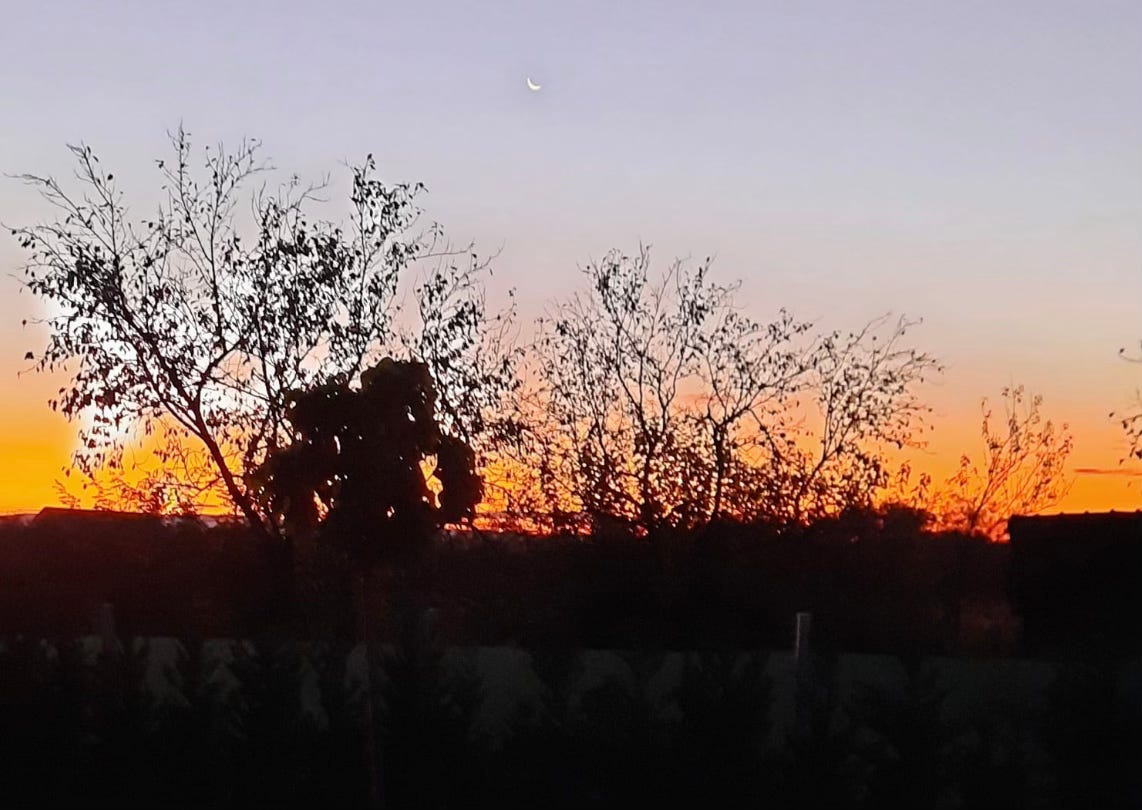
“I have only a fragment of the sky, but what a fragment!”
It’s rare to find a sentence that describes a place so truthfully, stripped of all pretence and projection, truthful to our experience of it. Language can condense a whole world into a very specific place, while an accurate photo of that place could diminish it into the most banal.4
I spent most of the flight back home going through Bhose’s book, inspired by her devotion to a language and a world which she was not born into, but felt compelled to enrich. And as I was rereading some parts of her Eminescu and Tagore essay, I was struck by another sentence, one not tied to a place, but to the blessing that certain curiosities, certain personal obsessions can bestow on our inner life.
In the paragraph, she describes her experience of translating a volume of Eminescu into Bengali over ten years, noting that “the translation was neither a literary experiment nor a linguistic exercise for me. It was a spiritual experience of living an inner life which I cannot define.”
Language, Amita’s honest reflection and Eminescu’s words, helped me remember how ideas, when carried well and served rightfully, can “throw a cloak over” our moving bodies. What that cloak signifies is for each of us to understand.
“All the ideas that float on the surface of human life are creations that throw a cloak over a moving body.” — Mihai Eminescu, Cezara
Thank you for reading.
Onwards,
Patricia
Amita Bhose (1933–1992) was an Indian writer, translator, and scholar who dedicated her life to building cultural and literary bridges between Romania and India. She translated Mihai Eminescu’s works into Bengali, taught Romanian language and literature at the University of Calcutta, and wrote extensively on the affinities between Romanian and Indian spiritual thought.
Schockerlebnis (plural Schockerlebnisse) is a German term meaning “shock experience.” It appeared in early 20th-century psychology and philosophy to describe sudden, intense experiences that interrupt ordinary perception. Walter Benjamin later used it to characterise the jolts of modern life, moments that fracture awareness yet awaken new ways of seeing.
Mihai Eminescu (1850 – 1889) is regarded as Romania’s national poet. His work blends Romanticism with philosophy, mythology, and metaphysics, exploring themes of time, love, nature, and the infinite. Eminescu’s language shaped modern Romanian poetry, and his influence on the country’s literary and cultural identity remains profound.
Susan Sontag argued in On Photography (1977) that modern culture has become “predominantly visual,” shaping not only how we perceive reality but also how we assign value to it. Photographs, she wrote, both frame and flatten experience, they can illuminate the world yet also reduce its mystery.